Riverbend County
A fictional county runs through the chapters, from early trust erosion and procurement practices to accountability without consequence. Readers see each concept at work in a setting that feels uncomfortably familiar.
A new book on public accountability
Corruption in public institutions rarely begins with a single act. It grows from weak oversight, tolerated shortcuts, and systems that look sound on paper but cannot enforce their own rules. The Cost of Trust shows how that happens, and what to do about it.
Publication date: January 31, 2027
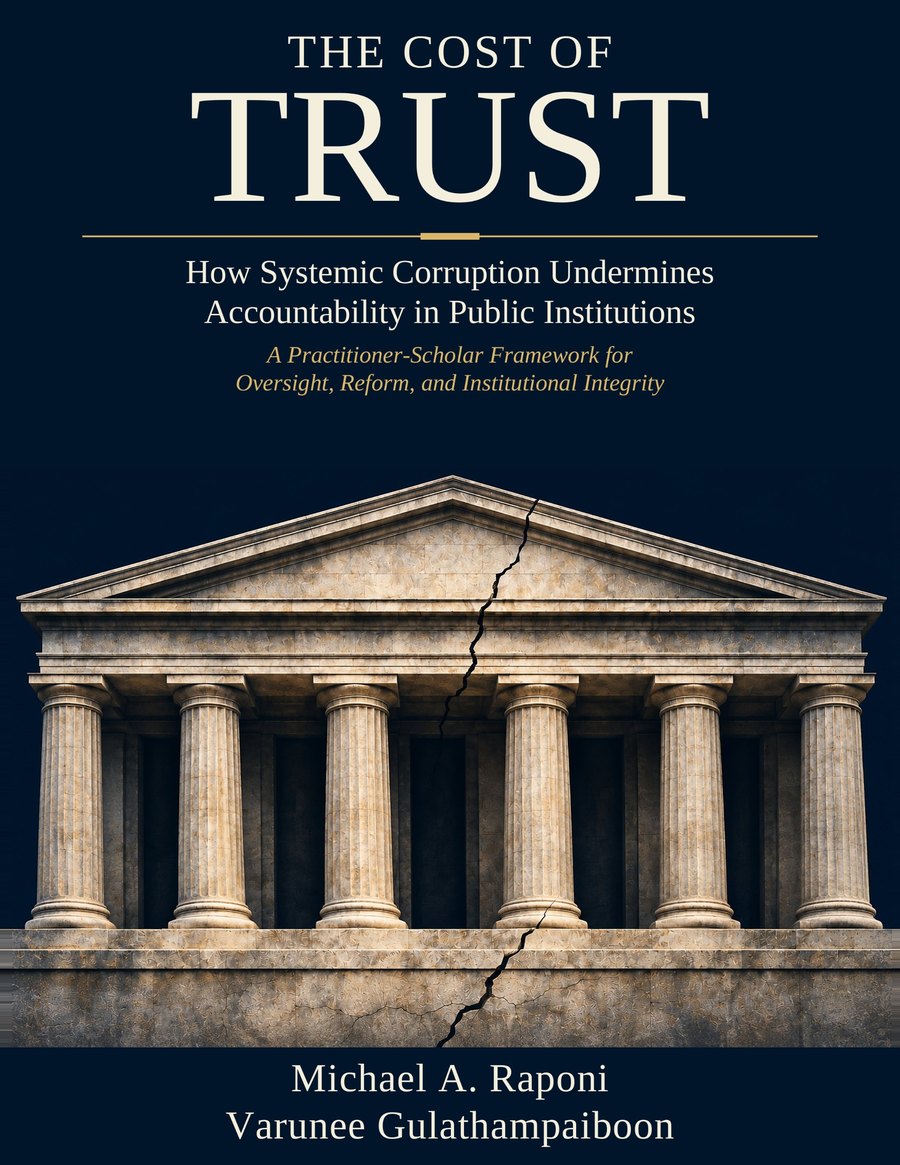
The book
When trust fails, the cost is paid by everyone.
Built on a practitioner-scholar framework, The Cost of Trust follows the full arc from foundations to reform: how public trust is built and measured, how individual lapses become systemic corruption, and why accountability fails without enforcement.
It then counts the cost, in dollars and in legitimacy, and shows how institutions rebuild and keep their gains across changes in leadership.
Every idea is tested against a fictional case that runs through the book, so readers can watch trust erode, and be rebuilt, one decision at a time.
Inside the book
Each chapter pairs a core framework with the Riverbend County case, then puts the idea to work with diagnostic tools, discussion questions and application problems.
Learn by doing
A fictional county runs through the chapters, from early trust erosion and procurement practices to accountability without consequence. Readers see each concept at work in a setting that feels uncomfortably familiar.
An interactive companion that lets readers practice the book's methods on sample data, turning diagnostic techniques into skills they can use on the job or in the classroom.
Who it is for
Public administration, criminal justice, and accounting.
A structured text with discussion questions, application problems, and companion teaching resources.
Diagnostic techniques for spotting drift before it hardens into structure.
Frameworks for strengthening accountability and sustaining reform.
Briefing
Public institutions depend on trust to carry out their responsibilities effectively. When accountability mechanisms weaken, the consequences extend beyond individual incidents of misconduct. Institutional credibility, public confidence and the effectiveness of public services can all suffer.
Understanding systemic corruption requires attention to the organizational conditions that allow problems to persist. Leadership decisions, incentives, internal controls and the treatment of warning signs can shape whether misconduct is detected and corrected or becomes embedded in routine practice.
Oversight is therefore more than identifying individual wrongdoing. It also involves examining the systems in which decisions are made, identifying vulnerabilities and encouraging reforms that strengthen accountability.
The Cost of Trust explores these issues through a practitioner-scholar framework, practical analytical tools and a continuing fictional case study. More briefings on oversight, ethics and institutional integrity will follow here.
The authors
Editions
US list prices. Retailer links will be added here as they go live.
Companion materials
Dedicated companion websites for The Cost of Trust. Both are password protected.
January 31, 2027
Be first to hear when The Cost of Trust is available, and when new briefings and teaching materials are added.